Northumbrian Climbing Guide |
||||||||||
|
|
|
Thrunton Crag
First time visitors to the crag are advised to locate West Buttress from which the other buttresses can most easily be located.
East Buttress
This buttress is the first to be reached and though hidden beneath the scarp edge its position can be located by a track on the left and a seat on the right 100 m before the main buttresses. An isolated Scots pine marks the top of the buttress and from it a path descends leftwards. The climbs are described from right to left.
1 Tree Chimney 9m VD
The vertical crack leads to an undignified but practicable stomach traverse left. (As an alternative swing up left below the traverse)
2 West Wall Route 12m MS
Climb the bulging wall using an obvious flake then move delicately right to finish.
3 Long Chimney 15m D
The chimney on the front of the buttress.
4 Long Climb 17m VD
Climb the slab to the left of the previous route and follow the blunt ar? to the top.
5 Short and Sweet 8m VD
The corner and crack on the Eastern side of the buttress is climbed direct and is easier than it appears.
6 Ignoramus 6m VD
Follow the awkward flake crack on the left side of the buttress.
7 Watty's Route 8m 4m VS 4c
The left hand crack gives good jamming to a holdless ledge which is gained by a precarious move.
8 John's Route 8m 4m VS 4c
The right hand crack which is awkward and strenuous.
No.7 Buttress Area
This area lies approximately 25 m from Flake Buttress and the approach is awkward to say the least. There are two buttresses with a slab, the Great Slab, beneath the Eastern one. The upper Eastern buttress has potential for a couple of easier lines for the adventurous, but the upper Western buttress is overgrown.
The Great Slab
This slab was originally dug out from the hillside, but has now been reclaimed by the vegetation and is so over grown that it is impossible to climb on. It has three lines, all being around Very Severe in standard. If you feel the need to do some extensive gardening, good luck.
The Tower of Flints
Best approached by descending between No 7 and The Tower of Flints buttress. This buttress is recognisable by means of the weird rock formations capping it. The rock is friable and the angle steep. The climbs are described from left to right.
9 Crown of Horns 11m 4m HS 4b
Climb the chimney and traverse right under the overhang. Climb this, moving directly up to the crown.
10 The Tower of Flints 11m 4m HS 4b
Start in the centre of the buttress. Climb the overhang direct to finish up the steep upper wall.
11 Corner Crack 11m VD
Climb the corner direct.
The Buttress Of Peculiar Perversions
This second buttress lies immediately to the West of the Tower of Flints.
12 The Creeping Queer 11m 5m E1 5b
Start at the left of the buttress beneath some overhanging blocks. Follow the traverse right and climb the overhang direct to an awkward finish.
13 Anal Intercourse 12m 5m E1 5a
Climb direct to the hole. From there bridge out and go straight up on large friable holds.
Central Buttress
Central Buttress lies about 50 m west and down the hill side. The approach is awkward and overgrown. The climbs are described from left to right beginning in the overhung bay.
Warning birds of prey sometimes nest in Savage crack. Barbed wire has been placed around the bottom of the buttress to prevent access. Care should be taken not to disturb them.
14 Big Bad Ad 14m 5m VS 5a 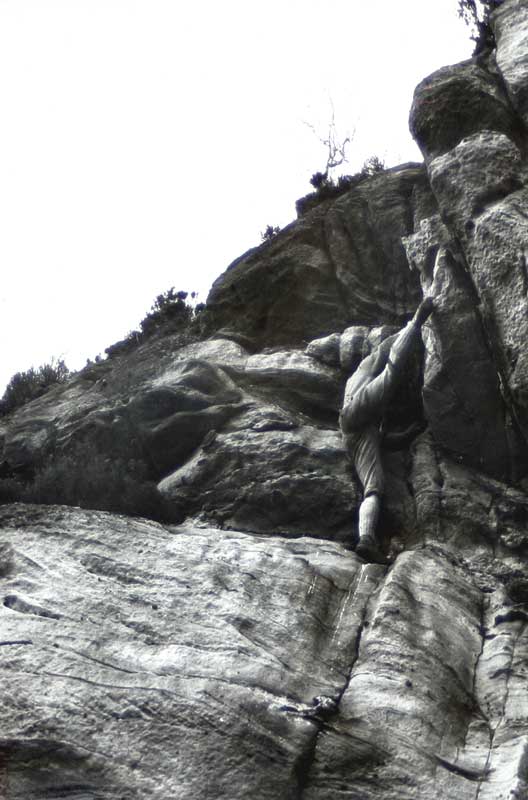
Climb the chimney in the right corner awkwardly and make a delicate rising traverse left and upwards. Move back right making for the obvious holds and follow a short layback to the top.
Gordon Thompson (April 1973)
(Solo)
(Solo)
15 Banner's Variation 5m E1 5b
Climb the roof crack direct.
16 Birthday Crack 9m 5m E1 5b
The thin crack on the right wall is hard to start but becomes progressively easier.
17 Savage Crack 11m 4m VS 4c
Climb the bulging crack in the front of the buttress and follow the easier corner to the top.To the right is a square-cut bay in which there are several overgrown routes of Very Difficult/ Severe standard.
18 The Unusual Wailing Wall 14m 4m VS 4c
Follows the slabs to the right of the bay, moving right at the top.
19 Quicksand 9m 4m HS 4b
The chimney on the West wall.
West Buttress Area
This is the prominent square-cut buttress, 150m west of Central Buttress, which is seen when approaching from the east It is less obvious when directly above and can be found by walking along the track until 3 road side pines are reached on the left 60m past a seat. Head north and descend trending left of the buttress. The first five routes are described from left to right, the rest which are much cleaner are described from right to left.
20 Guillotine 9m VD
Climb the West-facing wall by a crack and over blocks.
21 Jugs Incredible 14m VD
Climb the corner on good holds then a small groove leads to the top.
22 Unfinished Ar? 14m D
Go straight up the ar? on good holds.
23 Wanderer's Return 14m VD
Climb the obvious, gardened groove being wary of loose blocks.
24 Blind Pugh 15m 5m VS 5a
Climb to the overhang and then up the awkward impending crack.The right buttress is separated by a vegetated chimney though a few lines exist at Very Difficult/Severe standard in this area. The main buttress then rears up and the next route takes the shallow groove on its west side.
25 Thompson's Wonderful Route 17m 4m HS 4b
Climb the deceptive scoop to a ledge and make an exposed traverse left until it is possible to move up. Follow a crack and wall to the top.
26 Thrunton Front 14m 5m HVS 5a
A classic route. Climb a diagonal jamming crack, then move straight up into a scoop. Trend rightwards then awkwardly back left to a ledge. The crack above leads to the top.
Malcolm Rowe (1968)
27 Lord of the Flies 18m E1
Climb the thin crack a metre left of Thrunton Front and continue to a leftward trending scoop which is followed to a foothold on the left edge of the buttress. Climb the ar? passing a large ledge where the difficulty eases.
Lamb's Finish 5b
From the top of the initial crack continue up the crack above direct.
28 The Lurker 18m 4m HS 4b
Climb the chimney at the east end of the buttress to the ledge above the chockstone. Climb the steep wall to a jammed block and over the capstone on good holds.Further west are several scattered buttresses with a variety of routes which are suitable for those with exploratory or botanical interests.