Approach
From the A697 7km north of Longframlington, take the B6341 (Alnwick Rothbury) towards Alnwick. After 1.5km there is a layby on the right - Caller Boulders can be seen on the hillside above the road. The scattered rocks of Edlingham Crag can currently be seen in the remains of the wood left of the moor.
Routes
The rocks consist of a collection of disconnected butresses on the hillside above the turning to Edlingham. The hillside has recently been clear felled and is being left to naturally regenerate.
The rocks are arranged roughly in two tiers; the upper tier consists of some imposing looking buttresses, starting about half way along, and continuing to the Caller boulders; the lower tier consists of discontinuous buttresses which start above and to the left of the gate and run for two thirds the length of the hillside.
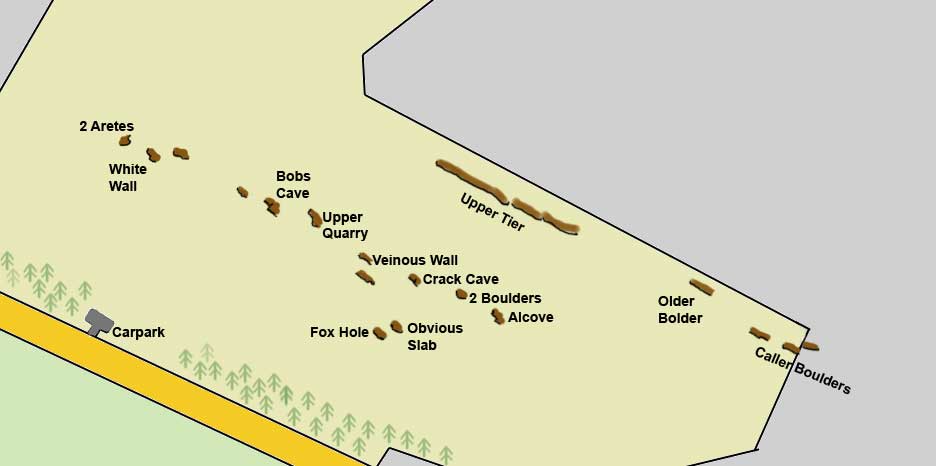
The lower tier is described first, then the upper tier. Within each tier, the buttresses and problems are described from left to right. Buttresses devoid of problems yet with potential are descibed, but those which the author considers as utter rubbish are omitted. Your milage may vary, feel free to e-mail details of anything you may think should be included to the link at the bottom right of this page.
LOWER TIER
Approach from the gate and follow old tractor tyre tracks to a path which lies below the rocks and runs parallel to the road. Upward progress is always easiest up the old tractor tracks, which were made by the gargantuan machine which ate up the forest. It's a bit of an art form avoiding the piles of dead trees when going between buttresses.
2 Aretes
Above and to the left of the gate is a small buttress with a rounded arete on the left, an arete rising out of a cave and a crack and slab immediately right of that.
White Wall
Immediately above the main roadside gate is a complex buttress with a white wall capped with an overhang at the bottom right and stepping up leftwards in a series of caves & overhangs.
Bobs Cave
To the right of white wall is a buttress with an obvious overhanging corner crack and a large cave to the right. Thanks to Chris Graham of northumberlandbouldering.co.uk for the descriptions and the cleaning!
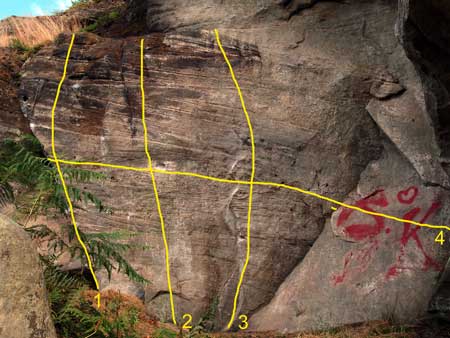
Sitting Start 6a
Braveheart 6c
The difficult sit start in the centre of the wall. Stack your fingers into the pocket and spend an hour or two trying to get past the dish to finish up problem 2.
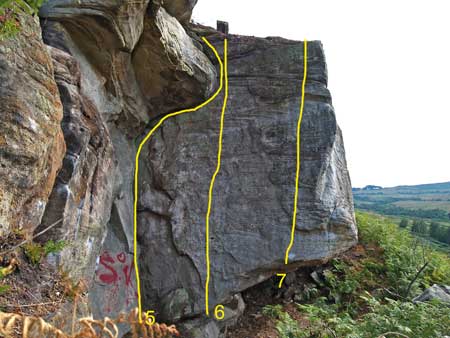
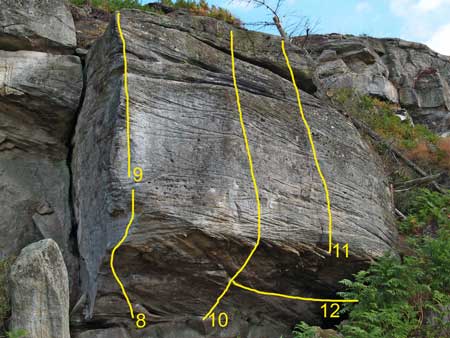
Around to the right is a roof, some one and a half body-lengths long followed by a headwall which reaches 6m in height.
Cave Arete 5c
The arete from standing.
Cave Headwall Centre 5c
The mantle and headwall.
Lone Boulder
Up and right from the car park, directly below and in line with Bob's Cave
Lower Wall
The last buttress in this tier consists of a dirty, featureless vegetated wall ending in an overhanging arete at it's right hand end. Past this arete is a cracked wall and the buttress ends with a large pile of boulders.
The next two buttresses actually lie below the lower tier.
Fox Hole
An overhanging buttress in a hollow 200 metres up and right of the fence
The Obvious Slab
Above and just right of Fox Holes is an obvious 5 metre slab.
Veinous Wall
A 5 metre high wall identified by some vein like protruding seams.
Low Neb
Just right of Veinous Wall, a small neb has a possible problem on it.
Cracked Cave
A large cave with a fierce crack coming out of it. Filled with logs at the moment.
Two Boulders
A pair of boulders next to each other.
The Alcove
The last buttress in this tier is a slabby affair, split by a crack and with a square cut alcove at it's lower left hand side.
UPPER TIER
Nothing is recorded on the largest buttresses on the left of this tier. The first problems are on the Golden Oldies buttress, best approached via Caller Boulders.
Golden Oldies
A longish, clean cut buttress with an overhang at half height and capped by a boulder in the middle.
Caller Boulders
There are two buttresses beside the fence which are really a part of the group of boulders called "Caller Boulders" in the main printed Bouldering Guide. The right hand one is described there. Since they are clearly in the wood they are also descibed here!
| © 2003 The Northumbrian Mountaineering Club | | Editing and website contact: |